

The Notes Playbook for Your First 1,000 Subscribers
Why your Notes get 4 Likes (and the data that fixes It)

This morning I did my biweekly Notes analysis, the one where I pull the engagement data on everything I posted. And one pattern jumped out at me again, so clearly that I decided to write this post instead of the one I had planned.
The Notes advice everyone gives you is: study the big accounts. Copy what works. Write like Dan Koe (325,000 subs).
I tested that advice with actual data. It’s wrong, and it’s wrong in a way that wastes months for smaller accounts.
Here’s what I found, what I do instead, and the exact system that made Notes the number one source of my subscribers.
The data that changed how I write Notes
Nicolas Cole has 124,000 subscribers. Most of his Notes get between 22 and 160 likes.
I found that while analyzing 500+ Notes from the biggest creators on Substack. Dan Koe writes the same kind of declarative, philosophical Notes and gets 1,000 to 2,600 likes per Note. Two giant accounts, the same style, completely different results. Even at the top, this style sometimes lands and sometimes doesn’t.
So the style can’t be the engine. For Koe, the engine is trust. 325,000 people decided to follow him before today’s Note ever reached them. When he posts three philosophical lines, his readers already believe the person behind them. The writing barely matters. The Note collects trust he earned over years.
And trust is the one thing you can’t copy. Take his exact sentences, post them on your account, and they arrive with no history attached. The stranger scrolling past doesn’t recognize you. Your Note has to make them stop, feel something, and hand over their email address, all on its own, starting from zero.
Different job. Different playbook.
So be careful whose Notes advice you take. The big accounts play with trust they already have. What you need is the playbook of someone who recently earned it from zero, on this platform, one stranger at a time.
Exclusive Access For My Premium Subscribers:
To help you grow faster, check out the resources waiting for you inside my Growth Library, available to premium members only.
That includes The Wander Wealth Playbook: my complete growth system with four systems, 10 fill-in templates, and workshop recordings, built from two years of growing this newsletter from 0 to 20,000 subscribers.
(If you aren’t a premium member yet, upgrade and unlock the full Playbook, the Notes scheduler, the templates, and everything else in the Library, so you can skip the mistakes I made.)
My own experience growing on Substack from 0
What I can tell you is that 2 years ago, I started here from 0. My audience and growth comes 50% from Substack Notes.
I don’t use any other social media platform, ads or anything else.
It’s 100% Substack.
So when I tell you I tested each and every strategy out there, you can believe me.
If you don’t believe me, believe my data. I figured out what works on Notes and what doesn’t if you are a small account. Specifically, if you are below 1,000 subscribers.
Now, my Notes go viral, on average they each get 100 likes and comments. They always compound over time.
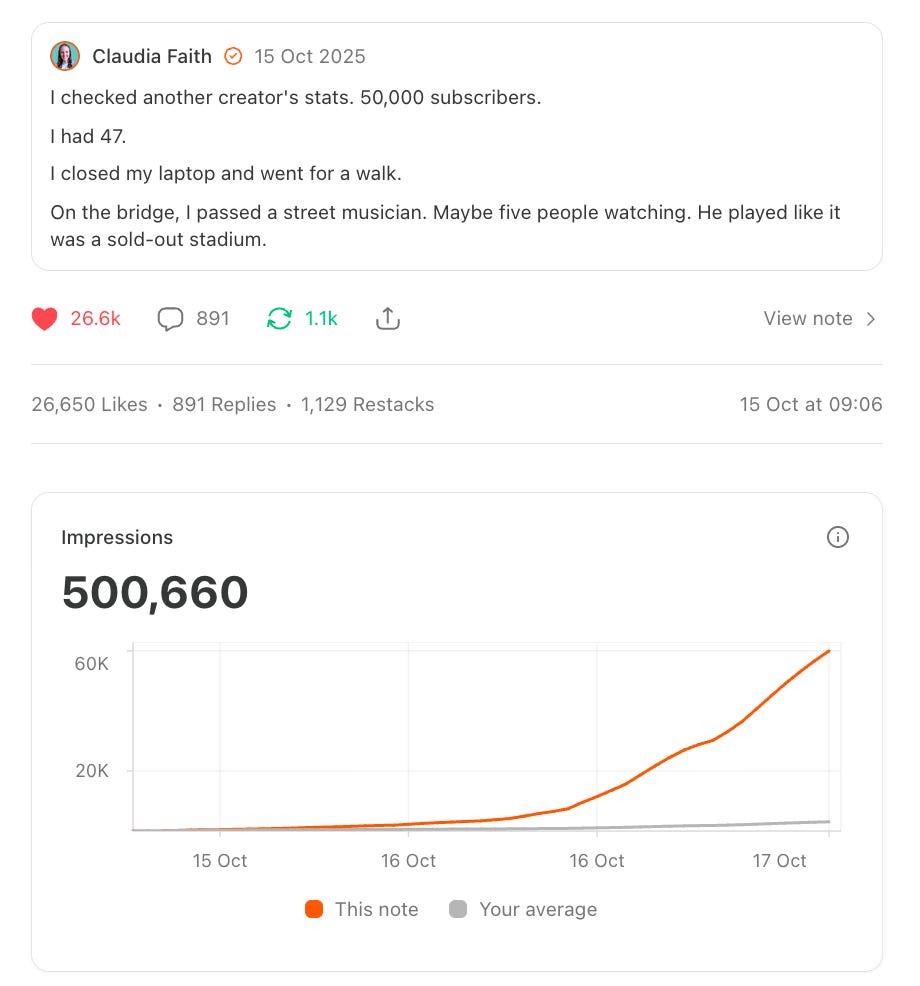
What actually works under 1,000 subscribers
If I were starting my Notes from zero today, this is the playbook. It’s built from my own numbers, not from watching famous people.
One: write from your real position. The most magnetic thing a small account can post is the honest middle. “My first 100 subscribers took 8 weeks” outperforms borrowed wisdom every time, because only you can say it. Big accounts can’t write small-account Notes. That’s your edge, not your handicap.
Two: specific numbers in the first line. My highest performers almost all start with one. Numbers stop the scroll because they’re checkable and concrete in a feed full of vague inspiration.
Three: vary your lengths deliberately. Some ultra-short truths, some 80-word insights, some 150-word stories. My analysis of both big accounts and my own shows different lengths catch different readers, and the algorithm seems to reward accounts that don’t feel like a template on repeat.
Four: end so the reader feels seen. Not “crushing it” energy. “I know exactly where you are, I was there” energy.
Five: reply to every single comment. At small scale this is rocket fuel: every reply doubles the Note’s conversation, and conversations are what the feed promotes. I still reply to everything, and I often get a small wave of subscribers just from working through my comments.
Six: post daily, but batch it. This is the one that changes lives, so it gets its own section.
The system: 21 Notes every Sunday in 30 minutes
Daily Notes presence is non-negotiable for growth. But daily creativity on demand is impossible for a normal human with a life.
The answer (for me) is batching. Every Sunday I write and schedule my Notes for the whole week in one sitting, about 30 minutes. Then I spend my daily Notes time on the part that can’t be batched: replying and having actual conversations.
My Sunday routine:
First, I look at what worked. Every two-three weeks I pull my Notes data and check which ones brought engagement AND which ones brought subscribers.
Then I write the week in one sitting: a mix of milestone numbers, one system breakdown, one honest struggle, one post share with a real reason, and a few short truths. Different lengths, one voice: mine.
Then I schedule them and close the tab. My week of presence is done before Monday coffee.
That’s the whole machine. One data check, one writing session, daily replies. When I got serious about this system, my growth went from a trickle to hundreds of subscribers per month, and it has never depended on any single Note going viral.
Viral is lovely when it happens. Consistent is what pays.
The whole Sunday routine runs on my Notes Scheduler. Premium members get the tool, plus the complete Grow on Substack Playbook.
Your next 14 days
Don’t overhaul everything. Do this:
Days 1-2: Write one Note with a specific number from your own journey in the first line. Post it. Reply to every comment.
Days 3-7: One Note per day, alternating: a short truth, a lesson with a number, a share of your best post with one honest sentence about why it matters.
Day 7: First mini-review. Which Note brought profile visits or subscribers? (Check your subscriber sources in your dashboard, not your likes.)
Days 8-14: Batch a full week in one sitting based on what you learned. Schedule it. Spend the freed-up daily time in the comments.
Premium members skip the manual part here. The Notes Scheduler batches and schedules the whole week in one sitting.
Two weeks. That’s enough to feel the machine start turning. From there it compounds, and I mean that literally: my Notes from months ago still bring subscribers every week.
Trust me, the feed has room for you. It just doesn’t have room for you pretending to be Dan Koe.
Was this helpful? 🧡
If you found this helpful, please share it with a fellow Substack writer who’s trying to grow their audience. Or leave a comment. We all grow together.
FAQ: Substack Notes for Small Accounts
Q: Do Substack Notes work for small accounts?
A: Yes. Notes are my number one subscriber source, but small accounts need a different playbook than big creators: specific numbers, honest-middle stories, and daily presence via weekly batching, not copied viral styles.
Q: How many Substack Notes should you post per day?
A: One per day is enough, if you show up every day. But I usually do 2-5 per day and I batch them: 21 Notes written and scheduled every Sunday in about 30 minutes, so my daily Notes time goes into replying to comments instead.
Q: Why do my Notes get likes but no subscribers?
A: It takes time to build up trust on Notes. What works: a specific number in the first line, a system with a result, a post share with an honest reason, and an ending that makes one reader feel seen.
Q: Should you copy viral Notes from big creators?
A: No. I analyzed 500+ Notes from the biggest accounts, and a creator with 124,000 subscribers still gets 22 likes on Notes in the exact style everyone copies. A small account’s Note has a different job: make a stranger stop, feel something, and subscribe.
Q: How long does it take to grow from Substack Notes?
A: Give it two weeks with a mini-review at day 7, checking subscriber sources instead of likes. Notes compound: my Notes from months ago still bring subscribers every week.
Claudia, the idea that a Note can collect trust earned over years changed how I read my own numbers. It is easy to mistake a lack of history for a verdict on the writing. Thank you for that distinction.
impressive curve that algorithm pumps